





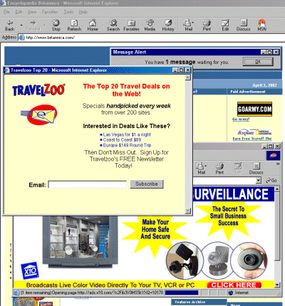
You click a link. You want the article. Instead, a window slams into existence.
It covers the text. It demands attention. You have to close it before you can actually read what you came for. This is the pop-up ad. It’s the digital equivalent of someone standing in front of your TV while you’re trying to watch the game. Annoying? Yes. Illegal in some places? Sometimes. But mostly, it’s just a friction point in your day.
What exactly is a pop-up ad vs a pop-under?
The name says it all. A pop-up jumps to the front. It screams “look at me.” It obscures the webpage you are trying to read. You have to move it or kill it.
Pop-unders are the sneaky cousins. They load behind your current tab or window. You don’t see them until you close the main page. Then there it is. Waiting for you. Because they don’t block your immediate view, they feel less intrusive. But they’re still ads. Still tracking you. Still trying to get a click.
Why do they exist? Revenue. Publishers need to pay bills. Advertisers need eyeballs. The problem is the method. It’s aggressive. It breaks the flow. And frankly, it’s outdated.
Why your browser blocks them (and why that matters)
Modern browsers are paranoid. And they should be. Chrome, Firefox, Safari — they all have built-in shields against unsolicited windows. You’ve probably seen the little icon in the address bar: a window with a cross through it.
That’s the pop-up blocker doing its job. It stops the script from launching the new window.
But here is the catch. Not all pop-ups are bad. Some are “expected” pop-ups. Like a login window for a hotel booking site. Or a confirmation dialog for a payment. Your browser tries to guess which is which. Sometimes it gets it wrong.
This is where the “opt-in” model comes in. If you click a button that says “Buy Now” and a window opens, the browser trusts you. It knows you initiated the action. That’s the key difference. Unwanted? Blocked. Wanted? Allowed.
The best defense against pop-ups isn’t just blocking them—it’s understanding why they trigger in the first place.
How to manage pop-ups without breaking the web
You can’t just turn off all pop-ups. Life will get harder. You’ll miss confirmations. You’ll struggle with legacy sites.
Instead, tune your settings. In Chrome, go to Settings > Privacy and security > Site Settings > Pop-ups and redirects. You’ll see a list of allowed sites. These are the ones you explicitly clicked to open. If a site is misbehaving, remove it from the allow list.
For Firefox, it’s similar. Settings > Privacy & Security > Permissions. Look for “Block pop-up windows.”
Is it perfect? No. Some sites use aggressive scripts that mimic expected behavior to bypass blockers. These are the ones that feel malicious. For those, you might need a dedicated ad blocker extension. But that’s a can of worms for another time.
The goal isn’t a sterile web. It’s a usable one. One where you control the
Why pop-up ads pay websites so much more
Here is the dirty secret of digital advertising.
You hate them. We all do.
That new window slamming onto your screen, demanding attention, cluttering your desktop… it feels like a slap in the face. But advertisers love the pain you feel.
Banner ads? They are background noise. You blink and they are gone. A banner might get two to five clicks per 1,000 impressions. That is pathetic. It is barely enough to keep the lights on for most sites.
Pop-ups are different.
They force interaction. You cannot ignore a window that sits on top of your browser. The result is stark. A pop-up ad might average 30 clicks for that same 1,000 impressions.
That is not a margin of error.
That is an order of magnitude difference.
Advertisers see that number and they write bigger checks. A lot bigger.
Typically, a pop-up ad pays the hosting website four to 10 times more than a standard banner ad. Ten times. If you are running a blog or a news site, that math is hard to ignore. The annoyance factor is high, sure, but the revenue per impression is undeniable.
This is exactly why you see so many pop-up ads on the web today. It is not an accident. It is a calculated decision based on cold, hard ROI.
“Whereas a banner ad might get two to five clicks per 1,000 impressions, a pop-up ad might average 30 clicks.”
It is efficient, in a ruthless sort of way.
Users suffer through the clutter to close the window. Advertisers get their eyes on the prize. Publishers get paid.
Everyone wins except your patience.
Is it worth it?
For the site owner, absolutely. For you? Probably not. But the market has spoken. The click-through rate dictates the strategy. And right now, the pop-up rules.