




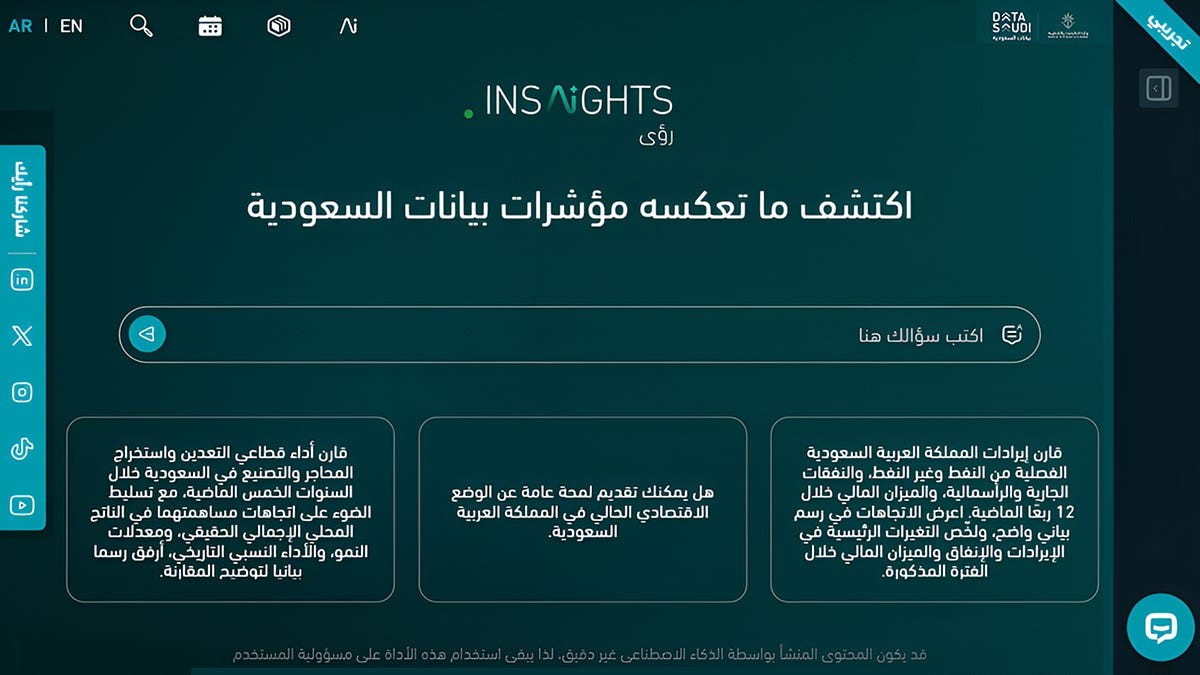
Data in Saudi Arabia is plentiful. Accessing it isn’t. That mismatch just got a serious fix.
The Ministry of Economy and Planning unveiled INSAIGHTS on the Data Saudi platform. This isn’t just a chatbot. It’s an agentic AI tool designed to dissect plain-language queries into instant analytics. It pulls from over 7,700 indicators. More precisely, more than 7,503 data points cover the nation’s socioeconomic landscape.
You ask. It answers. Simple? Mostly. Complex? Rarely now.
This launch directly serves Saudi Arabia Vision 2030. It targets transparency. It targets the public, researchers, analysts, and decision-makers alike. The barrier to entry has lowered significantly. Anyone with an internet connection and a question can now analyze the Kingdom’s economic pulse without a PhD in statistics.
Making Data-Driven Decisions Accessible to All
For years, the “data wall” existed for a reason: complexity. But global companies and local firms alike struggled to extract value from static portals. INSAIGHTS flips the script. By integrating AI agents into the platform, the Ministry is enabling real-time, natural language interaction with national datasets.
Think of it this way. Why wade through thousands of Excel sheets when you can just ask?
This represents a significant shift. Gulf governments often pilot AI in isolated, internal testing phases. Saudi Arabia is taking these agentic systems out of the lab and putting them front-and-center in public service infrastructure. It signals a move toward data democratization. Citizens can track progress. Investors can gauge trends. Analysts can spot anomalies instantly.
Why INSAIGHTS Matters for Global Business
The question is: how does this compare to existing databases? INSAUGHTS is distinct because of its natural language interface and real-time synthesis. It doesn’t just retrieve documents. It performs analysis on the fly. This reduces the time-to-insight from hours to seconds.
Consider the Saudi Vision 2030 National Transformation Program. A core tenet is leadership in digital innovation. This tool demonstrates tangible progress in that direction. It enhances the value of the 10-year economic overhaul by making data actionable. It transforms passive information into active decision-making assets.
For international partners, this means a more transparent window into the local market. You can explore sector trends. You can understand social shifts. You don’t need local expertise to ask basic, yet powerful, questions about economic health.
The Current Limits (Even for Beta Tech)
Here’s the catch: INSAIGHTS is in beta. The Ministry was candid about this. It is not perfect. Data coverage remains incomplete. Some datasets are lagging behind real-world activity.
Take the Ministry of Commerce data. As of 2025, there were 19,639 business licenses registered with “Artificial Intelligence” as the primary activity. Yet, INSAIGHTS does not currently ingest that specific Commerce Ministry metric. A gap exists between real-world business formation and data integration. It’s a technical debt that will likely clear as partnerships strengthen, but for now, blind spots remain.
Data consolidation from global sources began in earnest in 2023. The platform has since added multimedia features and periodicals. But AI requires clean, synchronized streams. Those streams take time to align. The Ministry plans to expand capabilities in the coming months. Updates are expected to plug holes. New indicators should roll in regularly.
Beyond the Beta: Where Things Go From Here
Is this a complete revolution in data accessibility? Not quite. It is a significant evolution. It offers a taste of what AI-powered governance could look like if fully realized. For now, it serves as a testing ground. The feedback loop from users to developers is active. Adjustments are continuous.
The real story isn’t the launch itself. It’s the trajectory. The shift from static reports to interactive intelligence mirrors a broader global trend. The Gulf is positioning itself at the intersection of traditional resource wealth and future-facing technology.
Data is the new oil, sure. But understanding it in real-time is the new refining process. Saudi Arabia is building the refinery. The AI tool is just the first conveyor belt.
There are still gaps to fill. Licenses go missing from reports. Sectors lag in coverage. The journey toward full transparency is ongoing. But the path is clear. We’re moving away from asking permission to view data, toward asking the data what it thinks.