



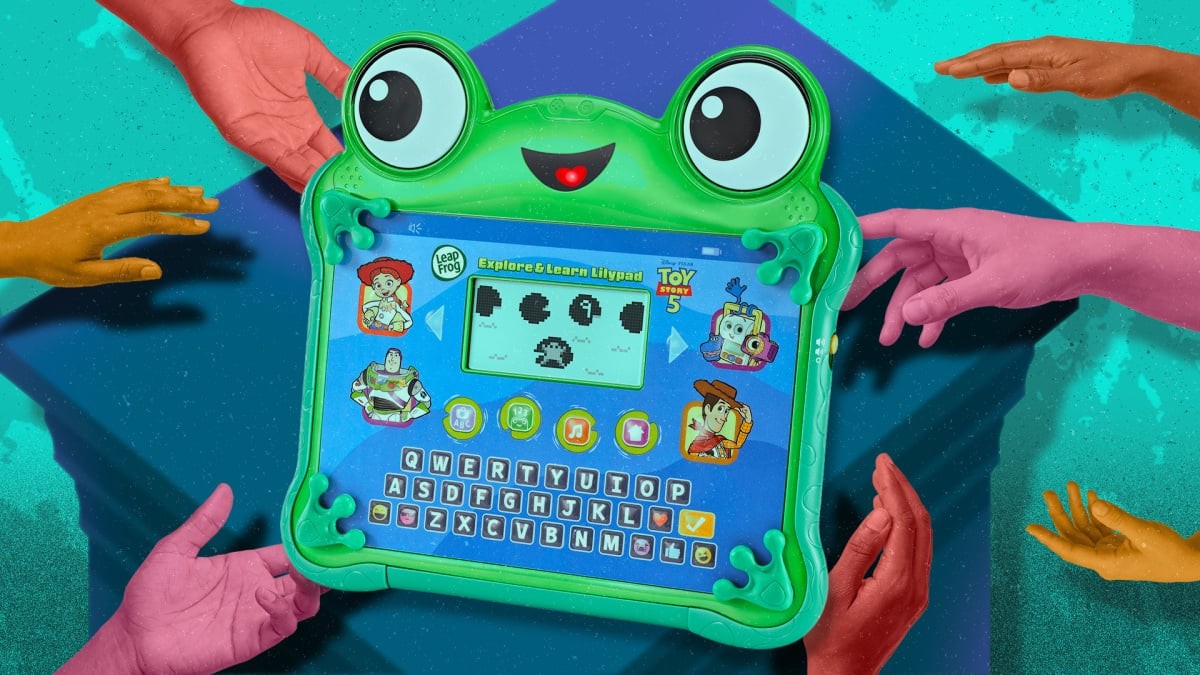
I have tested countless toys in my time as a parent and writer. None are as strange as the LeapFrog “Lilypad” tablet based on Toy Story 5. It costs $29.95. It tries to sell you friendship. It fails.
What Is This Thing?
The real-life gadget mirrors the movie villain. A flashy, mildly evil tablet that sets the plot in motion. Here, it has a backlit LCD screen. An A-Z keypad. Three “skill-building” games that teach counting to 100. Letter recognition. A simplistic obstacle course.
There is a music mode. Kids mash keys to “jam along.” You get sounds like ribbits, squeaks, and toilet flushes. Then there is Mendelssohn’s Wedding March. Why? The movie had imaginary weddings. Most kids won’t get it. Expect erratic sound effects. Random noise.
Then the emojis appear. Six of them. Thumbs up. Crying. Sunglasses. They look harmless. They are not.
Does It Match the Movie?
I felt relief. The toy is nothing like the film.
In Toy Story 5, the character Bonnie becomes a tablet zombie. She glows for hours. She abandons physical play for a toxic online pond. The villainous tablet helps mean girls bully her. It schemes to relegate her actual toys to the garage. It thinks it is helping.
The LeapFrog device has no AI. No autonomous creepy powers. Thank god. No toxic social media access. No peer-to-peer sharing of horror. LeapFrog limits engagement. Good move. The games are short. Repetitive, yes, but short.
The “Texting” Feature Is a Nightmare
This is where the design falls apart. The texting feature. It is the strangest choice.
You press buttons for Jessie. Buzz Lightyear. Woody. Smarty Pants. The device says, “Let’s see who’s on the Pond.”
Stop. That line is verbatim from the movie. It precedes Bonnie’s downward spiral into depression. It precedes the bullying. In a complete non-sequitur, this toy follows it up with, “Let’s stay connected!”
You pick a character. You get one of seven pre-programmed messages. Jessie asks, “Have you seen Woody?” You reply with a crying emoji. The machine responds, “Me too!” Or perhaps, “Message secured.”
Do not let your preschooler think a device offers empathy when they press a sad face.
Then it says it.
“Voila, friend made.”
It is the depressing, hollow equivalent of hitting “Accept Friend Request” on Facebook for a child. LeapFrog claims it celebrates interaction. I wonder if the designers saw the same film I did.
In the movie, the villain’s redemption arc begins when she realizes she cannot make friendships. She is a tool. A connector of real faces. Not a replacement for them.
This product ignores that entirely.
A Doctor Calls It Out
Dr. Jenny Radesky is a pediatrician at Michigan Medicine. She researches family screen time. I asked her why this exists.
“I wonder whether this was an underbaked that was put together for merchanduring purposes,” she said.
She calls the texting “odd.” She compares it to Character.AI. A platform where users chat with fictional personas. A platform currently sued by parents after teen suicides linked to chatbot abuse.
Lilypad has no AI. It cannot hurt anyone directly. But Radesky finds the mimicry of intimacy wrong. She would not let her own children use it.
She prefers a magnetic drawing board. Old school. Portable. Boring, maybe, but safe.
Who Is This For?
Not you.
Dr. Radesky notes that closed-loop games help rote learning. But kids play them on autopilot. They don’t engage. They zone out. LeapFrog argues they are helping parents find a “healthy balance” between tech and life.
Ben Miller, the designer, says it’s about approachability.
I hear them. I do. As a parent with strict screen rules, I respect the effort. Mindful technology integration sounds good in theory.
In practice, the Lilypad feels empty. It capitalizes on Toy Story zeitgeist. Disney and Pixar boost brand awareness. LeapFrog strengthens its market share. They hope these preschoolers graduate to the big LeapPad Academy tablets.
They are building lifetime customers.
We are told our relationship with devices is personal. The Lilypad suggests otherwise. It is a commercial transaction. Disguised as friendship. Disguised as learning. The market forces are doing the talking. Your child is just the audience.
What do we do next?