




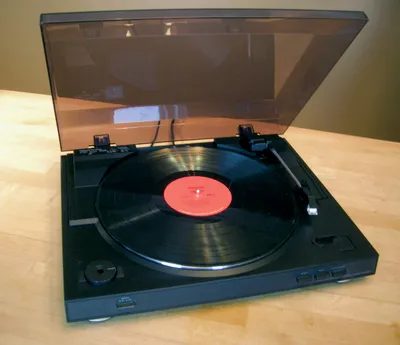
A phonograph doesn’t just play music. It physically translates mechanical movement into audible waves. The mechanism is surprisingly simple. A needle traces a spiral groove on a spinning disc. The groove isn’t random. It’s a direct replica of sound waves captured when the record was made.
Undulations in that sinuous track push the needle. The needle vibrates. Those vibrations are then reconverted back into sound. It’s a closed loop of mechanical energy. No digital code. No binary. Just physical ridges and valleys interacting with a stylus.
This was the first technology to truly capture and reproduce human voice and music. Before the phonograph, sound existed only in real-time. It vanished once it was spoken or sung. The disc locked it in time.
How the Groove Holds History
The disc stores audio as a series of physical bumps. These undulations are microscopic. They vary in depth and position based on the amplitude and frequency of the original sound. When the stylus follows this path, it moves. That movement is amplified.
The result is sound. The same sound. A faithful, albeit warm, copy of the original performance. It’s an analog process. Every wave is present. Every nuance is etched into the wax or vinyl.
The Shift from Cylinders to Discs
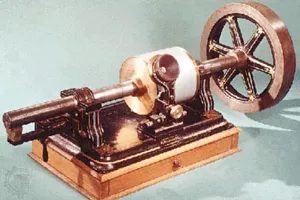
Thomas Edison didn’t invent sound recording out of thin air. Experimental setups existed as far back as 1857. But the invention of the phonograph is still universally credited to the American inventor in 1877. His early attempts were crude. He used a vibrating stylus to press indentations into a sheet of tinfoil. That foil was wrapped around a rotating cylinder. As the cylinder spun, the sound was physically etched into the metal. It worked. But it was fragile. The tinfoil tore easily. The quality was muddy.
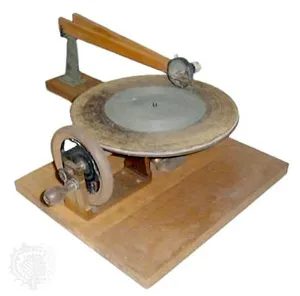
Improvements were inevitable. The biggest leap came in 1887. Emil Berliner changed the game entirely. He abandoned the cylinder. Instead of a helix spiraling around a tube, he traced sound grooves in a spiral on a flat disc. This was the birth of the flat record format.
Berliner’s method was scalable. He didn’t press copies directly. He created a negative from the flat master disc. That negative became a mold. Manufacturers could use that mold to stamp out hundreds of identical copies. Each copy reproduced the original master disc’s audio.
These flat discs needed a specific player. Berliner named his reproducing machine the gramophone.
Why the Disc Won
The gramophone vs phonograph distinction matters. It wasn’t just branding. It was geometry. Cylinders were heavy. They took up space. They wore out quickly because the stylus rode the same physical groove repeatedly. Discs were different.
- Mass Production : The mold system allowed for cheap, rapid duplication.
- Durability : Flat discs were easier to store and stack.
- Standardization : The spiral groove on a flat surface became the industry standard.
Edison’s tinfoil was a novelty. Berliner’s wax-coated zinc disc was a product. The technology shifted from a laboratory curiosity to a household commodity. The history of vinyl records starts here, long before vinyl itself existed.
“These ‘records,’ as they came to be known, could be played on a reproducing machine Berliner named a Gramophone.”
The name stuck. The format won. The cylinder eventually vanished. The disc remained.
The Vinyl Evolution: From 78s to Stereo
The mechanics of pressing vinyl records didn’t stay static. Methods for molding disc records improved steadily through the early 1900s. By 1915, the 78-RPM record had solidified its place as the industry standard. It wasn’t much to look at by today’s metrics. Each side held about 4 1/2 minutes of audio. That was the limit of analog storage before electronics caught up.
Then came the 1920s. Electric loudspeakers entered the picture. They amplified reproduced sound volume, making records actually listenable in larger rooms. The sound was no longer just a faint whisper from a horn. It had presence.
Columbia’s 33⅓ Revolution
The game changed again in 1948. Columbia Records introduced the long-playing (LP) record. They didn’t just make it louder. They changed the speed and the physical structure of the groove.
Rotating at 33 1/3 RPM with incredibly fine grooves, the LP could hold up to 30 minutes per side. This was a massive jump from the 78s. Musicians and listeners could now hear full symphonies or concept albums without flipping a tiny disc every five minutes.
RCA’s 45 RPM Singles
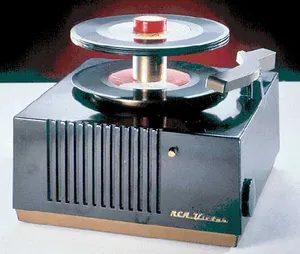
RCA Corporation didn’t sit still. Shortly after Columbia’s launch, they introduced the 45-RPM disc. It was faster. It could play for up to 8 minutes per side. This format became the home of the single. The LP became the home of the album.
These two formats—the LP and the 45-rpm single—completely supplanted the 78s during the 1950s. You wouldn’t find a 78 in a mainstream home by the end of the decade. The infrastructure had shifted entirely.
The Birth of Stereo
It wasn’t just about capacity. It was about space. In 1958, stereophonic systems became a commercial reality. This was a significant upgrade over monaural sound. Stereo placed two separate channels of information into a single groove.
If you played a stereo record on a mono system, you got a blended, flat sound. But on the right hardware, the audio opened up. You could hear instruments separated in a virtual space.
This required better hardware. Stereo phonographs capable of undistorted reproduction became essential. They weren’t just accessories. They were components of what we now call a high-fidelity sound system. The gap between the source and the ear narrowed. The 33 rpm and 45 rpm formats remained the dominant physical media for decades, carrying that stereo signal with increasing clarity.
The anatomy of analog sound
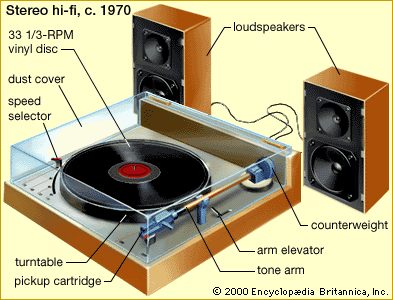
Look at any modern phonograph setup and you’ll see the same five-part skeleton. It’s a chain of conversions. The record spins on a turntable. A stylus digs into the groove. That physical tracking moves a pickup, which turns mechanical vibration into electrical impulses. An amp takes those weak signals and cranks them up. Finally, a loudspeaker translates the electricity back into something your ears can hear.
It’s simple enough. But the devil is in the details.
The stylus isn’t just a needle; it’s a precise instrument tracking microscopic variations. The pickup, often called a cartridge, is where the magic starts. It doesn’t just “hear” the record. It measures displacement. Whether it uses a moving magnet or a moving coil changes the sound profile entirely.
The chain is only as strong as its weakest link. A $500 cartridge on a flimsy tonearm will sound worse than a $50 one on a rigid platform.
The amplifier doesn’t just make things louder. It shapes the tone. Cheap amps introduce hiss. Good ones preserve the dynamic range. And the loudspeaker? It’s the final boss. It has to turn invisible waves into pressure changes in the air.
This isn’t just history. This is the blueprint. Every streaming service, every Bluetooth speaker, even your phone’s earbuds, follow this same basic logic. Convert physical data to electricity. Boost it. Make sound. The medium changes. The physics stay the same.
You might think digital audio skips this entirely. It doesn’t. It just hides the mechanics. The DAC (Digital-to-Analog Converter) is just a fancy pickup. The amp is still there. The speaker is still moving air. The elegance of the phonograph is that you can see the process. You can see the cause and effect.
That visibility matters. It reminds you that sound is physical. It’s not just data. It’s movement.
The vinyl era ends
Gramophones and vinyl records held the crown as the primary way to hear recorded music in the home for decades. This dominance lasted until the 1980s. Then the format shifted. Cassettes and compact discs stepped in to replace the bulky turntables. The era of heavy analog spinning discs effectively closed. Sound recording moved into plastic and digital.