


You probably don’t think much about the math you do daily. Splitting a dinner bill. Calculating a tip. Filling out a tax form. You grab a phone, or a physical calculator, and you’re done. It feels like these tools have always been there. A given.
But that wasn’t always the case.
Electronic calculators didn’t become household staples until the late 20th century. Before that, numbers were a manual grind. People used their fingers. Then they used older, bulkier tools. The abacus is one famous ancestor. It likely originated in Babylon. Early versions were boards where counters represented values. The modern abacus moves beads on wires. People still use them in parts of China, Japan, and the Middle East.
For a long time, professionals had different options. Some used motor-assisted mechanical adding machines. Others relied on mathematical tables. Then there were slide rules. These devices used movable, graduated scales. You could handle multiplication with them. Or trigonometry. It required skill. And practice.
The game changed in the 1960s. Integrated circuitry improved. That led to the first electronic calculators. Companies like Sharp and Texas Instruments built them. They looked nothing like the slim devices we use now. They were boxy. Heavy. Expensive.
Why does this history matter today? Because consumer demand for smaller calculators drove innovation. That demand helped create the microchips powering our current gadgets. The evolution of the electronic calculator is really a story about miniaturization. About making technology fit in your pocket.
The Road to Miniaturization
The shift from mechanical to electronic wasn’t just about speed. It was about space. The early electronic versions were prototypes. They proved the concept. But they weren’t ready for your bag.
Sharp and Texas Instruments were pioneers. They figured out how to integrate circuits into a single unit. This was a huge leap. It moved computation out of the office and into the personal sphere.
But the devices were still large. They didn’t fit the lifestyle of the average consumer. People wanted something portable. Something convenient. That need for portability became the engine for change. It pushed engineers to shrink components. To pack more power into less space.
This pressure for size directly influenced chip design. The need for a small calculator helped birth the modern microchip. We see the results every time we turn on a smartphone. The journey from the abacus to the app starts with that push for small. It starts with the desire to carry less weight. And do more math.
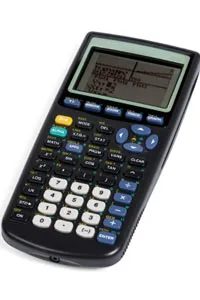

Sharp might have laid the early groundwork with the CS-10A in 1964, but the real shift happened when calculators stopped looking like cash registers and started fitting in pockets. That transition began with Texas Instruments’ “Cal Tech” project, which produced the first handheld unit capable of basic arithmetic. Canon took that tech and sold the first commercially viable version in 1970. It was thick as a pack of cigarettes and cost $400.
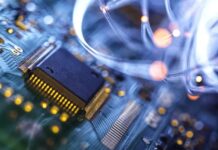
The engine behind this miniaturization was the single-chip microprocessor. Before the late 1960s, building a computer’s brain required a messy tangle of separate chips. The microprocessor changed everything by packing an entire CPU onto one piece of silicon. Intel debuted the first commercially available version, the 4004, in 1971.
This hardware leap allowed calculators to evolve from simple adding machines into programmable tools. Today’s graphing calculators can handle hexadecimal systems, scientific notation, and complex trigonometry. They use high-precision constants like pi and e, solve equations, and analyze statistics. When Texas Instruments released the TI-92 in 1995, they marketed it as having the power of a computer lab.
How Input Becomes Output
You press a button, but what actually happens inside the casing?
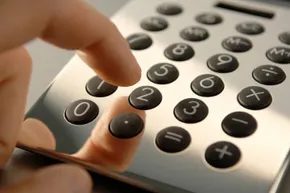
Most modern shells are durable plastic with holes for rubber buttons. Pressing one completes a circuit underneath. The electrical impulse travels to a circuit board, gets routed to the microprocessor, and finally results in a display reading. It’s a straightforward chain of events.
The display itself tells the story of power efficiency. Early models relied on LEDs. Newer ones use liquid crystal displays (LCDs). LEDs generate light. LCDs just rearrange existing light molecules. That difference matters because LCDs sip electricity.
Powering the Device
You used to plug these things in or lug around heavy batteries. The late 1970s changed that with affordable solar cell technology. Photons hit silicon semiconductors, knocking loose electrons. An electric field directs these electrons into a current. An LCD calculator needs such low power that its solar panel can be tiny.
By the 1980s, solar was standard for basic models. Scientific and graphing calculators still rely on batteries due to higher power demands.
Next, we’ll look at binary code and how the calculator actually processes numbers.
A Note on Calculator Spelling
There is a specific name for the upside-down language created by calculator displays. It’s called BEGHILS, referencing the letters most commonly formed by digits (like 07734 for “hELLO”). It’s a niche piece of trivia, but it shows how deeply embedded these devices became in everyday culture.
Most standard pocket calculators rely on integrated circuits to function. These chips, populated with thousands of transistors, handle the heavy lifting. They add and subtract. They compute logarithms. They tackle multiplication, division, exponents, and square roots. The rule of thumb is simple. More transistors mean more advanced capabilities.
But beneath the plastic casing lies a binary system. Every input you type is reduced to base-two code. Binary numbers use only 1s and 0s. Each position doubles in value as you move left. Turning a “position” on (setting it to 1) signals that the digit is included in the total.
Microchips execute this logic by literally switching electricity through transistors.
Take a simple example: 2 + 2.
The calculator converts each “2” into binary: 10.
It adds the columns.
The ones column has two 0s. Sum is 0. The chip notes the empty first position.
The tens column has two 1s.
Since binary has no “2,” the sum carries over. The positive result moves one digit to the left. The result is 100. In binary, that equals 4.
That sum travels through the input/output chip. The same binary logic applies to the screen. Have you ever wondered why calculator digits look like segmented lines? Each segment is a tiny circuit. The processor translates “100” by lighting specific segments to form the numeral 4.
This mechanical precision wasn’t always this small.
The Difference Engine Predecessor
Long before microchips, the concept of automatic calculation existed. An engineer in the Hessian army proposed a machine in 1786. He called it a difference engine. Its purpose was to print mathematical tables. It calculated differences between equations sequentially. This automation made it a direct precursor to the modern computer.
Decades later, a Swedish father-son team, the Scheutzes, built a working model in 1853. It still sits at the Smithsonian Institute today. It proves that the core logic of calculating differences has been central to computing history for over two centuries.
The shift from abacus to algorithm wasn’t just about speed. It was about accessibility. Calculators democratized computation, turning complex math from a barrier into a tool. In classrooms, they unlocked higher-level concepts for students who previously struggled with basic arithmetic. But this convenience comes with a catch.
Some educators still ban them in lower grades. The goal? Force kids to internalize problem-solving techniques rather than outsourcing the logic. You can’t learn to walk if a wheelchair carries you everywhere. Yet in high school calculus and trigonometry, graphing calculators are often mandatory. The curriculum demands visualization that pen and paper can’t always provide efficiently.
The Cheating Dilemma and Cognitive Cost
Here is where it gets messy. Powerful calculators have sparked controversy. Critics argue that overreliance erodes fundamental mathematical intuition. Recent studies on advanced physics students suggest that leaning too heavily on mathematical aids can actually hamper learning outcomes. If you skip the struggle, do you truly understand the concept?
Then there is the cheating issue. Some schools have outright banned graphing calculators. Why? Because their high memory capacity allows students to store forbidden data. Periodic tables. Formulas. Even full test answers. It is easy to program a cheat sheet into a TI-84 if you know how. This isn’t just a student issue. It is a technological one. The device is too capable.
Engineering the Future of Compute
Engineers are still pushing boundaries. The line between a personal computer and a classic calculator is blurring. Modern devices are becoming more complex, more powerful. Companies are also looking at sustainability. We are seeing more ecologically sound components. Recycled materials. Even used cellular phone parts finding new life in manufacturing. Efficient power sources are being developed to reduce waste. It is a small step, but it matters.
Beyond the Handheld: Digital Calculators
Calculators have moved online. They are no longer just plastic bricks in your pocket. They are web tools with massive databases behind them. Here are the types you will actually use:
- Weight-loss calculators measure body mass index, track caloric intake, and estimate workout impact. They don’t just compute numbers. They contextualize your health data.
- College loan and mortgage calculators help determine the total cost and length of loans. You input variables. The tool outputs the reality of your debt.
- Conversion calculators handle everything from volume and length to real-time currency exchanges. You don’t need to memorize exchange rates. The web does it for you.
- Carbon footprint calculators estimate your environmental impact. They translate abstract habits into concrete data.
These tools use the same core principles as your hand-held device. But they offer ease of use and access to vast amounts of related information. Anyone can use them. This proves calculators are no longer just for engineers, scientists, or accountants. They are for everyone.
The Microprocessor Revolution
If terms like “integrated circuit” or “microprocessor” sound familiar, it is no accident. Intel’s introduction of the single-chip microprocessor paved the way for nearly every electronic device we use today. Computers. Televisions. Microwave ovens. All of them rely on this technology. But it all started in the calculator.
The first microprocessor appeared in a calculator. This is a fact often overlooked in tech history books. The demand for compact, efficient computation drove the innovation. The calculator was the proving ground. Without that initial application, the modern computing era might have looked very different.
Frequently Asked Questions
Can a calculator be wrong?
Yes. A calculator is only as good as its calibration and condition. If it is malfunctioning or not properly calibrated, it will output incorrect results. Garbage in, garbage out. Or rather, broken tool, broken math.