




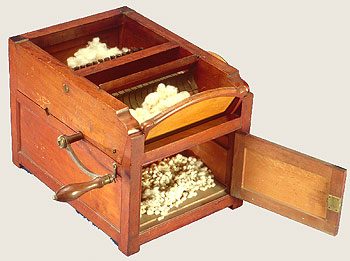
The cotton gin changed everything. Or rather, it broke everything.
In 1793, a mechanic named Eli Whitney walked into a problem that defined the American South. Picking cotton by hand was brutal work. It took forever. It kept profits low. And it relied entirely on enslaved labor. Whitney didn’t just invent a tool. He invented an industrial lever.
The device was simple. Brutally so.
The Mechanics of Separation
Whitney’s machine, the “cotton gin,” used rotating circular saws. These blades moved between parallel metal bars. Think of them as bars of a cage. The saws pulled the cotton fiber through the gaps. The seeds? They were too big. They stayed behind.
“The seeds of cotton, being too bulky to pass through the bars of the gin, are thus separated from their fiber.”
This process was fast. A single machine could do what a hundred people could not. Before this, separating seeds was a slow, manual grind. After this, it was mechanical. The shift was immediate. And catastrophic.
The Patent Paradox
Whitney filed for a patent on March 14, 1794. He expected royalties. He got theft instead.
The machine was easy to copy. Farmers built knockoffs. They ignored the patent. The legal battles dragged on for years. Whitney lost money. He lost patience. He stopped inventing altogether.
“Difficulties in exploiting the use of his patent would constrain the inventor to no longer patent any invention.”
It is a bitter irony. The man who sparked a textile boom gave up on intellectual property entirely.
Why It Matters Today
We still use the principle. The basic mechanism of saws pulling fiber through bars remains relevant. It is the foundation of modern cotton processing. But the historical cost was higher than anyone calculated in 1793.
The cotton gin didn’t just make cotton cheaper. It entrenched slavery. It made the plantation economy profitable again. It tied the South’s fate to the crop more tightly than ever.
The machine worked. Too well.