




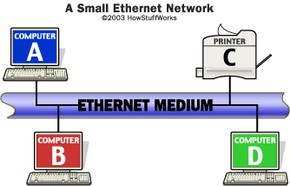
Ethernet does more than just send data like a personal telephone. It’s more like a shout in a crowded room. The signal reaches all devices connected to the wired or wireless segment. This shared medium means that destination addresses are not only useful. they are required. Without these, the device cannot know who the message is intended for.
Consider a simple configuration. Computer B wants to send a print job to printer C. The frame moves along the wire. Computers A and D also heard it. They intercept electrical signals. But here is where the logic kicks in. Each station immediately looks up the MAC address of the target.
If the address matches its hardware ID, it stops and reads the payload. If no match is found, it will be rejected. They discard the frame before even looking at the actual data. This saves processing power. It keeps the network from bogging down with irrelevant traffic.
But there’s a problem. A specific type of address breaks this rule. broadcast address.
If the frame is sent to a broadcast address, no normal filtering is applied. All nodes in the network receive it. All nodes handle it. It works for everyone. This mechanism is important for network discovery and management. Without transmission, devices cannot find each other or communicate their presence effectively.
Frames with a destination address equal to the broadcast address is intended for every node on the network.
This distinction defines how local networks scale. Unicast traffic filters the noise. Broadcast traffic ensures that no one is left in the dark. This is a fundamental trade-off between efficiency and accessibility.