



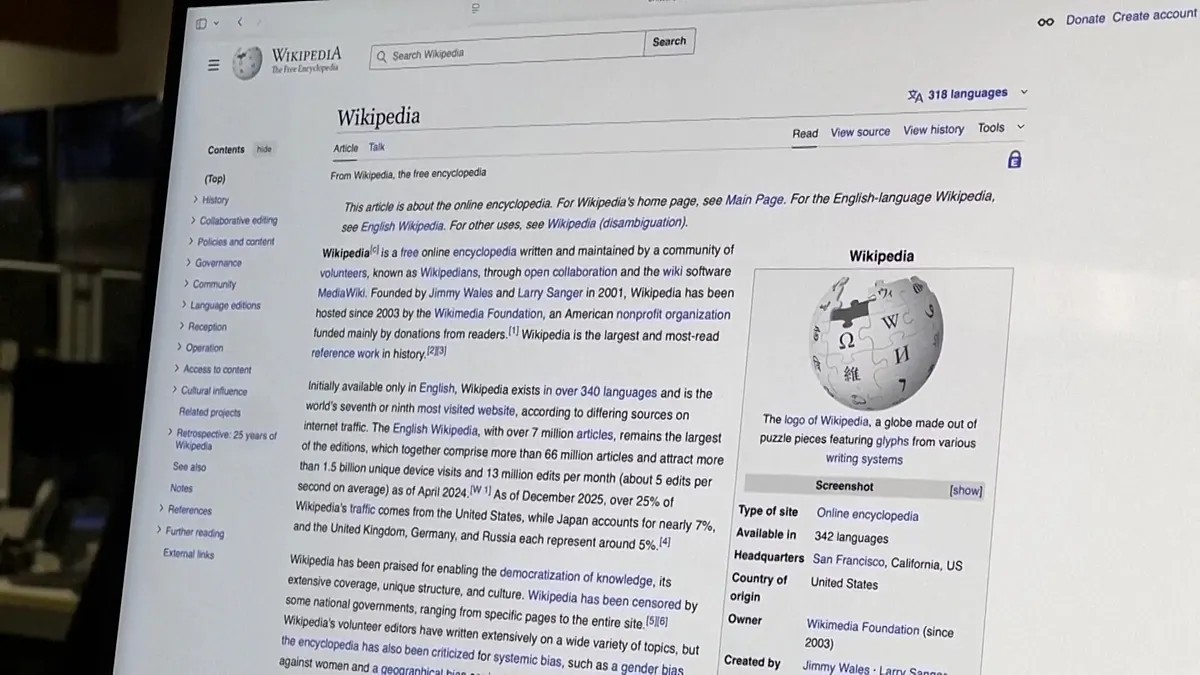
Wikipedia has begun directly charging major artificial intelligence (AI) firms – including Amazon, Meta, and Microsoft – for access to its vast knowledge base. This move comes as AI companies increasingly rely on Wikipedia’s data to train their large language models (LLMs), putting significant strain on the free encyclopedia’s servers.
The Problem: AI’s Strain on Wikipedia
For years, Wikipedia has operated primarily on public donations. However, the surge in AI usage has created a new challenge: AI models consume immense bandwidth and computing resources when scraping Wikipedia for training data. According to Jimmy Wales, Wikipedia’s founder, AI firms have been “hammering” its servers.
This is not a minor issue. Wikipedia is a critical source of human-curated knowledge, and its sustainability relies on fair compensation for its use. The Wikimedia Foundation, the nonprofit behind Wikipedia, has made it clear that donations are meant to support free access for readers, not to subsidize commercial AI development.
The Solution: Wikipedia Enterprise
Wikipedia is now offering commercial access through its “Wikipedia Enterprise” product. This allows AI companies to legally reuse and distribute Wikipedia’s content. The goal is simple: AI firms must contribute financially to the upkeep of the platform they heavily depend on.
CEO Maryana Iskander notes that reliance on Wikipedia is growing both from human users and AI tools, highlighting the importance of sustainable funding.
Existing Agreements & Future Implications
Wikipedia already has a similar deal with Google (established in 2022) and partnerships with other AI firms like Anthropic, Perplexity, and Mistral AI. Wales emphasizes that AI companies should “chip in and pay for their fair share” of the costs they impose.
This marks a significant shift in how knowledge infrastructure is funded. Wikipedia’s move sets a precedent: if AI relies on publicly sourced data, those who profit from it must contribute to its maintenance. The future of free knowledge may depend on AI firms recognizing their dependence and paying for it.
In essence, Wikipedia is asserting that human-curated knowledge has value, and those who benefit commercially must contribute to keeping it free and accessible for all.