




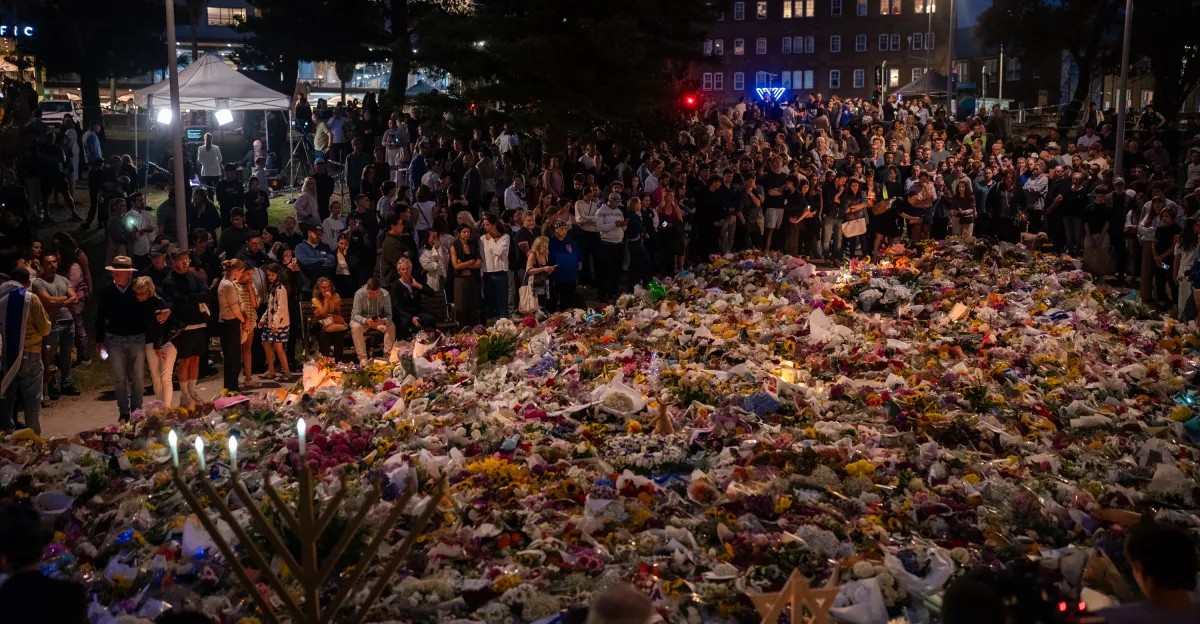
Recent high-profile attacks – a mass shooting at a Hanukkah celebration in Sydney, Australia, and an assault on US soldiers in Syria – are raising urgent questions about the resurgence of the Islamic State (ISIS). While the group no longer holds vast swathes of territory, evidence suggests it remains a potent force, capable of directing or enabling attacks in the West and expanding its reach in unstable regions.
The Sydney Attack: More Than Just “Motivation”
Australian Prime Minister Anthony Albanese acknowledged the Sydney shooting was “motivated by Islamic State ideology,” but experts suggest the connection is far deeper. The attackers, a father-and-son duo, reportedly received military training in the Philippines, an area with an active ISIS affiliate. Counterterrorism analyst Colin Clarke of the Soufan Center argues this indicates a “directed” or “enabled” attack, not merely spontaneous radicalization.
The timing is critical: this attack occurred alongside a separate ISIS-affiliated assault on US forces in Syria, the first American casualties in the country in a year. The pattern echoes “green on blue” attacks in Afghanistan, where partnered forces turned against Western troops – a tactic that hastened the US withdrawal.
ISIS: Diminished, But Not Defeated
ISIS has undergone significant changes since its peak around 2014-2015, when it controlled territory equivalent to Great Britain. The territorial “caliphate” has been eliminated, and its ranks have shrunk to an estimated 3,000 fighters. However, the group never truly disappeared.
- ISIS-inspired attacks, though now overshadowed by extremism from other ideologies in the US and Europe, continue to occur.
- The group maintains a strong presence in conflict zones like Syria, where the number of attacks is rising post-Assad.
- Most alarmingly, ISIS is expanding rapidly in Africa, with major affiliates in the Sahel region, DRC, and Somalia.
The group’s current leader, Abu Hafs al-Hashimi al-Quraishi, is believed to be based in Somalia, indicating a potential shift in operational focus. Despite its fractured state, experts suggest ISIS retains centralized coordination between affiliates across Africa, Asia, and the Middle East.
The Online Radicalization Pipeline
ISIS leverages social media to recruit and radicalize new members, exploiting global grievances like the Israel-Gaza conflict. Many attacks in Europe appear to be carried out by “lone wolves” radicalized online, guided by “cyber-coaches” who provide logistical support remotely. This makes recruitment cheaper and less risky than traditional training camps.
The Sydney case highlights this trend: the suspects legally acquired firearms and traveled to an ISIS-active region despite prior investigations. This raises questions about intelligence gaps and potential failures in monitoring known threats.
Shifting US Priorities and the Risk of Re-Engagement
US foreign policy has gradually shifted away from counterterrorism towards “great power competition” with China and Russia, as well as domestic issues like narcotics and migration. The latest National Security Strategy does not even mention ISIS, warning against overextending resources on what it deems a “less consequential area.”
However, the US has quietly increased airstrikes in Somalia targeting ISIS, suggesting a continued, albeit lower-profile, engagement. The Biden and Trump administrations have both signaled a willingness to withdraw from Syria, a move ISIS may exploit to regain ground.
If attacks targeting Western troops or civilians escalate, the US could be forced back into a more aggressive counterterrorism posture. The situation is volatile, and the recent surge in ISIS activity suggests the threat is far from contained.
The resurgence of ISIS is not just a regional issue; it represents a broader failure to address the underlying conditions that fuel extremism. The group’s ability to adapt, exploit instability, and leverage online radicalization means that Western governments must reassess their counterterrorism strategies before the threat spirals out of control.