


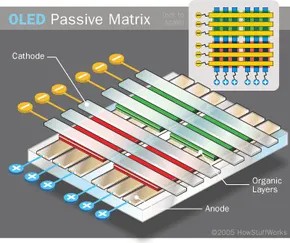
Not all OLEDs are created equal.
There are many confusing choices on the market. Transparent panels. Top-emitting structures. Foldable screen. White organic layers. From car dashboards to wearable technology, each technology serves a different purpose. However, before you get lost in these niche variations, you need to understand the basic difference between passive matrix displays and active matrix displays.
This difference determines light control, device battery consumption, and why MP3 players look different from smartphones.
How Passive Matrix OLED (PMOLED) works
Passive-matrix OLEDs, or PMOLED are based on a relatively crude but efficient architecture.
Imagine strips of cathode running vertically. Cross them with strips of anode running horizontally. The organic layers sit right in between. Where these strips intersect, pixels form. Light emits only at those specific crossing points.
An external circuit controls this process. Current is passed through selected anode and cathode strips to illuminate specific pixels. When the power is turned off, the pixels go dark. brightness? This is directly proportional to the amount of current used. Simple.
But simplicity comes at a price.
PMOLEDs consume much more power than their active counterparts. Why? This is because the external circuitry requires constant power to control pixel selection in the network. It is less efficient for complex images, but works well with static or semi-static content.
Where PMOLED fits into your technology stack
So which devices actually use this technology?
PMOLEDs excel at displaying text and simple icons. They are not designed for high resolution video or complex graphics. Therefore, they are best suited for small screens, typically 2-3 inches diagonally.
You’ll find them in older or budget-friendly cell phones, PDAs, MP3 players, and more. Industry prefers them because of their efficiency compared to their competitors at the time. Even taking into account the power consumption of external circuits, PMOLED devices consume less battery than the LCD screens that previously powered these portable devices.
If you’re looking for a PMOLED advantage in modern environments, it’s ease of manufacture. Easier to manufacture than active matrix types. This low barrier to entry reduces the cost of small, single-use displays where visual fidelity takes a backseat to battery life and cost.
But as displays grew in size and complexity, this passive approach collapsed due to its own power requirements. That’s when the industry shifts gears.
Bright pixel mechanism
While passive matrix displays have struggled to improve efficiency during their development, active matrix OLEDs have turned the tables. The structure is relatively complex. You get a stack of a regular cathode, organic molecules, and an anode. But underneath the anode is something important: an array of thin film transistors (TFTs).
Think of your TFT group as a local command center. Instead of relying on external circuitry to make pixels emit light individually (a slow and power-intensive process for large displays), TFTs form a matrix. Each pixel has its own switch. This matrix determines exactly which pixels are on. It’s precise. It’s fast.
Why AMOLED wins in terms of size and speed
The efficiency gains are not just theoretical. Because TFT arrays handle switching internally, they consume less power than the external drivers required by passive displays. This makes the Active Matrix OLED technology sustainable for larger resolutions.
Passive design is stifled by too many pixels. Active designs thrive in them.
Another potential advantage of this architecture is the refresh rate. The internal exchange enables faster updates. Video doesn’t stutter. Motion stays crisp. This isn’t just about gaming monitors. It’s all about scaling.
This is why AMOLED has an advantage in certain areas. These powerful high-end computer monitors where color accuracy and response time are important. They drive large-screen TVs. It lights up an electronic bulletin board, and its brightness and durability cannot be ignored. This technology doesn’t just look good; Works better under load.


